What 5G NR means?
5G NR (New Radio) is the fifth generation of mobile communications technology (5G), a globally harmonised standard developed by 3GPP for 5G mobile communications networks, designed to provide higher data rates, lower latency, better network capacity and coverage to support a wide range of application scenarios and services.
5G NR (New Radio) is a new radio access technology (RAT) developed by 3GPP for use in 5G (fifth-generation) mobile communication networks. It is a globally accepted standard for the air interface of 5G networks. 3GPP’s 38 series of specifications defines the technical details for NR.
3GPP’s research on NR started in 2015. The first release of the specification came out at the end of 2017. At that time, the 3GPP standardisation process was continuing and the industry was already working on the implementation of those infrastructures that follow the draft standard and expects the initial large-scale commercial deployment of 5G NR to happen in 2019.
5G Mobile Networks Like 2G, 3G, and 4G mobile networks, 5G networks are digital cellular networks in which the service area covered by a provider is divided into several small geographic areas called cells. Analogue signals representing sound and images are digitised in the cell, converted by an analogue-to-digital converter, and transmitted as a bit stream.
All 5G wireless devices in the cellular communicate via radio waves with local antenna arrays and low-power automated transceivers (transmitters and receivers) in the cellular. The transceivers allocate channels from a common pool of frequencies that can be reused in geographically separated cells.
The local antennas are connected to the telephone network and the Internet via high-bandwidth fibre-optic or wireless backhaul connections. As with existing mobile phones, when a user traverses from one cell to another, their mobile device will automatically switch to the antenna in the new cell.
The main advantage of 5G networks is that data rates are much higher than previous cellular networks, up to 10 Gbit/s, which is faster than current wired internet and 100 times faster than previous 4G LTE cellular networks.
Another advantage is lower network latency (faster response times) of less than 1 millisecond compared to 30-70 milliseconds for 4G. Due to faster data transfer, 5G networks will not only serve mobile phones, but will also become general home and office network providers, competing with wired network providers.
What are the 5G NR network features?
- Peak rates need to reach the Gbit/s standard for large data transfers such as HD video, virtual reality, etc.
- The air interface latency level needs to be around 1ms to meet real-time applications such as autonomous driving, telemedicine, and so on.
- Ultra-large network capacity to provide the connectivity of hundreds of billions of devices to meet IoT communications.
- Spectrum efficiency should be improved by more than 10 times that of LTE.
- User experience rate of 100Mbit/s under continuous wide area coverage and high mobility.
- Traffic density and connection number density are substantially increased.
- System synergism, intelligent level enhancement, manifested as multi-user, multi-point, multi-antenna, multi-uptake synergistic networking, as well as flexible automatic adjustment between networks.
The above is the key to distinguishing 5G from previous generations of mobile communications, and is the result of the gradual transformation of mobile communications from technology-centred to user-centred.
What are the 5G NR technology advantages?
Higher data rates
Lower latency
Reduced latency in data transmission supports real-time applications and services such as intelligent transport systems, telemedicine, and industrial automation.
Enhanced network capacity and coverage
5G NR enhanced network capacity and coverage through more efficient spectrum utilisation, smarter network management, and multi-entry, multi-exit (MIMO) technology, supporting coverage in densely populated areas as well as across wide geographic areas.
Multiple connection type support
5G NR supports different types of connectivity, including enhanced mobile broadband (eMBB), ultra-highly reliable low-latency communications (uRLLC), and massive machine-type communications (mMTC), to meet the needs of various application scenarios.
New spectrum resource utilisation
5G NR introduces millimetre-wave bands and high-frequency bands (e.g., Sub-6 GHz and mmWave) to expand spectrum resources and provide greater bandwidth and higher rates.
Flexible network architecture
5G NR introduces virtualisation and software-defined networking (SDN) technologies to support flexible network configuration and resource allocation, improving network flexibility and scalability.
What are the 5G NR technology disadvantages?
Cost problems
High cost of infrastructure construction and upgrading in the early stage of deployment.
Coverage
Especially, the coverage of the millimetre wave band is limited; more base stations are needed to achieve continuous coverage.
Penetration loss
High-frequency band signals have high loss in building penetration and environmental obstacles.
Device energy consumption
Battery life may be affected, especially for millimetre wave devices and early end devices.
5G NR frequency bands
The 5G NR band is divided into two frequency ranges in general.
Frequency Range 1 (FR1), which includes bands up to 6 GHz.
Frequency Range 2 (FR2), which includes bands in the millimetre wave range (20-60 GHz).
The global 5G first bands are the C-band (spectral range 3.3GHz-4.2GHz, 4.4GHz-5.0GHz) and the millimetre wave bands 26GHz/28GHz/39GHz. accordingly, the 3GPP has tailored n77, n78, n79, n257, n258 and n260.
5G adopts a broadband approach to defining frequency bands, creating a handful of globally harmonised frequency bands, which greatly reduces the complexity of terminals (mobile phones) to support global roaming.
5G’s maximum bandwidth has been increased from 20 MHz to support a maximum of 100 MHz on C-band and 400 MHz on millimetre wave. The speed of a download or an upload will be dramatically increased.
In addition, 5G uses more advanced symbol shaping techniques, such as Filter-OFDM, which reduces the overhead of the protection band at the edge of the spectrum, and compared to 4G, the transmission bandwidth is significantly improved with the same nominal bandwidth.
5G NR Service-Based Architecture
Compared with the 4G network system architecture, based on point-to-point interfaces between network elements and network elements, the control plane of the 5G core network is a Service-Based Architecture (SBA).
The 5G NR Service-Based Architecture supports on-demand deployment of network functions and services, enables flexible network slicing, and reduces the TTM of new network services, enabling rapid service innovation.
The 5G NR Servitisation Architecture adopts the principles of componentisation, reusability, and self-containment to define network functions, which provide services to other network functions that are allowed to use their services through their common servitisation interfaces.
5G NR network slicing
The most significant key difference between the 5G system architecture and previous generations of mobile communication systems is network slicing, which was supported to some extent in 4G networks through the feature of ‘proprietary core networks’.
In contrast, 5G network slicing is a much more powerful concept that encompasses the entire PLMN. In the context of the 3GPP 5G system architecture, network slicing refers to a set of 3GPP-defined features and functionalities that together comprise a complete PLMN network that provides services to the UE.
5G NR network slicing allows for on-demand composition of network functions into PLMNs based on control, which provide their features and defined services based on specific application scenarios. For example, there can be mobile phone slicing, Telematics slicing, Telemedicine slicing, IoT slicing, etc.
The application of 5G NR network slicing technology will lead to the deep integration of the communications industry with other industries, and will surely give rise to new business models and accelerate the pace of digital transformation in the industry.
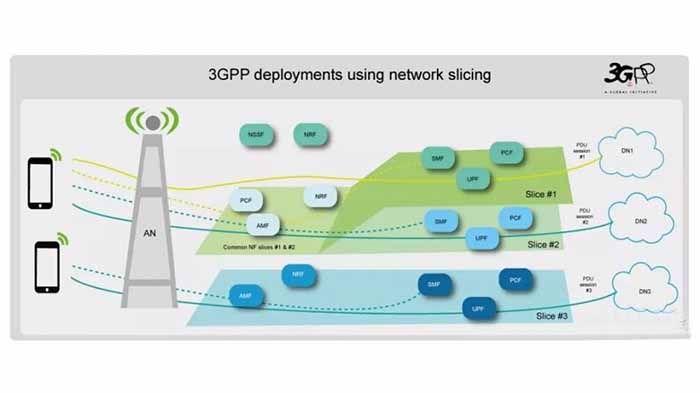
3GPP 5G network slicing deployment applications
5G NR Edge Computing
5G NR Edge Computing reduces transmission delay and the need for high bandwidth for network backhaul by migrating application services to the edge of the network and localising service content.
It also realizes two-way interaction between the network and applications, which effectively improves the intelligence of the mobile network and facilitates the convergence of the network and services to enhance the service level.
Edge computing technology becomes a natively supported feature of 5G networks, and the idea of edge computing is integrated into all aspects of the design of the entire 5G system.
Communication architecture with two-way interaction between the network and the application;
Flexible deployment and flexible selection of user-plane, including the impact of applications on user-plane selection;
Multi-anchor sessions (simultaneous access to local and cloud) service continuity support (SSC mode);
Local access network support (LADN);
Flexible QoS mechanisms to accommodate multiple services.
5G NR Unified Authentication Framework
The 5G NR unified authentication framework enables the 5G network to support multiple trust states, integrate different types of access technologies and terminal types, and improve the scalability of the operator’s network for new service scenarios and vertical industries by supporting new authentication protocols (e.g., EAP) and converged authentication interfaces and network elements.
D2D communication for 5G NR
In 5G networks, network capacity and spectral efficiency need to be further improved, and richer communication modes and better end-user experience are also the evolutionary direction of 5G.
Device-to-device communication (D2D) has the potential to improve system performance, enhance user experience, reduce the pressure on base stations, and improve spectrum utilisation. Therefore, D2D is one of the key technologies in future 5G networks.
D2D communication is a cellular-based technology for direct transmission of short-range data, and the data of D2D sessions are transmitted directly between terminals without being forwarded by the base station, while the related control signalling, such as session establishment, maintenance, wireless resource allocation, billing, authentication, identification, mobility management, etc., are still handled by the cellular network.
The introduction of D2D communication in 5G NR cellular networks can reduce the burden on the base station, lower the end-to-end transmission delay, improve the spectral efficiency, and reduce the transmit power of the terminal.
When the wireless communication infrastructure is damaged or in a blind area of wireless network coverage, the terminal can achieve end-to-end communication or even access the cellular network with the help of D2D. In 5G networks, D2D communication can be deployed in both authorised and unauthorised frequency bands.
M2M communication in 5G NR
As the most common application of IoT, M2M (machine-to-machine) has been commercially applied in the fields of smart grid, security monitoring, city informatisation, environmental monitoring, etc. 3GPP has formulated some standards for M2M networks and has set up a project to start researching key M2M technologies.
There are two definitions of M2M: broad and narrow.
Broadly speaking, M2M mainly refers to machine-to-machine, human-to-machine, and mobile network-to-machine communication, and it covers all the technologies that realise the communication among people, machines, and systems;
In a narrower sense, M2M refers only to machine-to-machine communication. Intelligence and interactivity are the typical features of M2M that distinguish it from other applications, and the machines under this feature are also endowed with more intelligence.
5G NR applications
5G NR (New Radio) is a core component of the fifth generation of mobile communications technology, designed to provide wireless access technology with higher speeds, lower latency, greater connection density, and higher energy efficiency than previous generations of technology (e.g., 4G LTE).
5G NR applications are used in deep applications and solution development in vertical fields such as autonomous driving, telemedicine, industry 4.0, and smart cities.
Telematics and autonomous driving
Telematics technology has gone through the stages of using wired communication roadside units (road signs) and 2G/3G/4G networks to carry in-vehicle information services, and is gradually moving into the era of autonomous driving based on high-speed mobile communication technology.
Surgery
The most immediate application of 5G technology is likely to be improved video calling and gaming experiences, but robotic surgery is likely to hold great promise for specialised surgeons performing operations on people in need around the world.
5G technology will open up many new areas of application for which previous mobile data transmission standards were not fast enough. The speed and lower latency of 5G networks meet the requirements for telepresence, and even telesurgery, for the first time.
Smart Grid
Due to the high security requirements of power grids and the breadth of full coverage, smart grids must achieve a high reliability of 99.999% in a measurement and processing system with massive connectivity and wide coverage;
The simultaneous access of a large number of end devices, ultra-low latency of less than 20 ms, as well as deep coverage of terminals, and smooth signals are the basic requirements for their safe operation.
Etc.
5G NR meets 5G multi-scene and diverse service requirements and improves overall network performance through flexible and configurable frame structure, bandwidth, and system parameters, and key technologies such as multiple antennas.
Besides the What is 5G NR article, you may also be interested in the below.