This article is about what is 5G NTN, and 5G NTN Satellite Internet 33 Q&A to help you understand the latest solutions for 5G NTN technology.
NTN (Non-Terrestrial Network) technology, based on 5G satellite-to-terrestrial communications, provides secure and reliable broadband connectivity to remote areas that lack terrestrial network coverage.
Widely deployed 5G NTN can bring health, safety, and economic benefits to populations in remote areas, while enhancing the supporting environment for economic operations in industrial sectors such as agriculture, energy, healthcare, and transportation.
What is 5G NTN technology?
5G NTN is the mainstream direction for the development of Star-Earth converged communication, which mainly includes two technical routes: IoT NTN and NR NTN.
The former is based on the evolution of NB-IoT technology, focusing on supporting IoT services, providing low-speed data transmission, short messages, and other functions; the latter is based on the evolution of 5G NR technology, focusing on supporting broadband data, voice, and fixed wireless access and other functions.
5G NTN lays an important technical foundation for the next-generation air-air-heaven integrated converged communication system, to achieve 6G one network, unified airport transmission, unified access control, unified authentication, and unified network architecture, and seamless switching between star and earth.
Satellite Internet has become a new hotspot in the development of satellite communications, and the international standardisation organisation 3GPP has launched further research and standardisation work on satellite communication networks as a necessary supplement to terrestrial networks, which is called Non-Terrestrial Networks (NTN) in 5 G-NR Release 17.
5G is a major turning point in the evolution of wireless communication technology. Its speed, latency, capacity, flexibility, and reliability are all vastly improved compared to 4G, opening the door to new usage models.
However, 5G also places greater demands on network uptime and coverage, requiring the wireless industry to develop and adopt new pillar technologies. While previous cellular technologies were developed entirely on terrestrial network infrastructure, 3GPP intends to add satellites to 5G networks to strongly complement the performance of terrestrial 5G networks.
These non-terrestrial networks (NTNs) will extend the reach of 5G to areas lacking terrestrial infrastructure. 5G NTNs can also enhance business continuity for machine-to-machine (M2M) and Internet of Things (IoT) devices, and improve the reliability of mission-critical communications. They can also provide stable 5G coverage for passengers on mobile platforms such as planes and trains.
5G NTNs will play a critical role in many industries, including transport, public safety, healthcare, energy, agriculture, finance, and automotive.
Why use non-terrestrial networks?
The 3GPP Release 17 standard defines 5G New Radio (NR) enhancements developed to support NTN. 5G NTN marks the beginning of the use of satellite communications in cellular networks. Satellite links were introduced into the 5G standard for several reasons. The main reason is that satellite links can communicate without relying on terrestrial infrastructure.
Mobile network operators (MNOs) can use satellite communications to deliver 5G services to areas that lack infrastructure. Satellite communications also support MNOs in delivering services in the event of terrestrial network disruptions, such as in the event of a natural disaster.
Satellite communications also allow 5G services to be extended to a wider range of mobile platforms. For example, satcom can provide services to aircraft, ships, and trains in remote areas where terrestrial network infrastructure cannot be built.
Another advantage of 5G NTN is that satellite links can extend existing terrestrial networks or ‘fill in’ their gaps. For example, M2M and IoT applications located at the edge of coverage or in hard-to-reach locations can access 5G over satellite broadband links.
Figure 1 shows several different NTN deployment scenarios that use both satellites and high-altitude platforms (balloons, blimps, or UAS in the stratosphere).
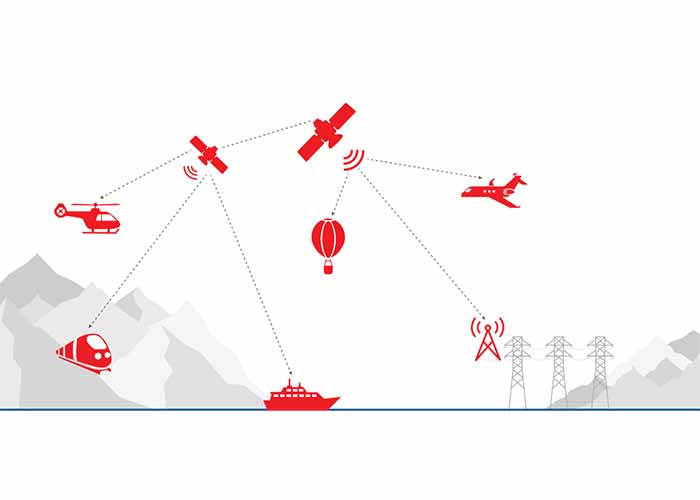
Satellite links provide 5G connectivity for mobile and isolated platforms
Advantages of 5G NTN
Wider coverage compared to traditional terrestrial networks. Since NTN networks operate at high altitudes, they can cover vast areas without the need for extensive terrestrial infrastructure. This makes 5G NTN networks a reliable way to provide connectivity to remote and rural areas where traditional infrastructure is not practical.
Ideally, 5G NTN networks can reach speeds of up to 20 Gbps, allowing for fast and efficient processing of large amounts of data. This makes it ideal for applications that require real-time data processing, such as remote monitoring, surveillance, and self-driving cars.
Disadvantages of 5G NTN
Despite the many benefits of 5G NTN technology, there are some challenges:
One of the main chapters is the cost of deployment.
Building and launching satellites and other aerial vehicles is a costly endeavour, and these costs may take a period of time to be recouped by revenues from network operations.
Another disadvantage of 5G NTN technology is its unreliability compared to traditional terrestrial networks.
Since the network is operating wirelessly from high altitudes, it is susceptible to dryness from terrain, weather, and other factors that can disrupt the wireless network. This means that 5G NTN networks may not be able to provide connectivity in harsh environments. Another factor that affects 5G NTN ability is atmospheric attenuation.
When a signal travels through the atmosphere, it can result in a weakened or distorted signal. This can be caused by a variety of factors, including humidity, temperature, and pressure.
The possibility of cyber attacks and other security breaches as the network operates at high altitudes, prone to being monitored and protected.
What are 5G NTN applications?
5G can support links with more stringent latency requirements than previous generations of communication technologies.
Since signals to and from LEO take time to travel, 5G NTN satellite communication links should support specific applications where latency is less critical, reducing the communication pressure on terrestrial networks. Delay requirements are a key factor that must be considered when determining which applications NTN can support.
3GPP has defined several scenarios for the use of 5G NTN, some of which are as follows.
Multi-connectivity
As one of the main usage scenarios for 5G NTN, multi-connectivity enables the user equipment (UE) to connect to both terrestrial and satellite links. In this usage scenario, time-sensitive, low-latency traffic is transmitted over the terrestrial link, while mission-critical traffic is transmitted over the satellite link.
Fixed cellular connectivity
To help make 5G services available to users in remote areas or industrial sites such as offshore oil platforms.
Mobile cellular connectivity
To help provide seamless 5G mobile cellular network coverage for aircraft and high-speed rail passengers. This process uses terrestrial networks where they are available and satellite links in remote areas where terrestrial cellular networks are not available.
Other applications
Terrestrial networks with gaps in coverage can be combined with satellite links to achieve seamless coverage. The access point can determine when and how to forward traffic from the terrestrial network to the satellite network.
Similarly, 5G NTN can increase network resilience, preventing complete network outages by aggregating multiple network connections in parallel, thus maintaining high availability of critical networks.
The technology also helps to build wide-area IoT satellite links to assist terrestrial networks in providing wide-area IoT services for applications with relatively long latency, such as energy networks, transport, and agricultural applications.
Direct satellite links can also support emergency communications between public safety agencies, police, fire departments, and hospitals.
5G NTN can also improve direct-attached node broadcasting or direct-attached mobile broadcasting for broadcasting emergency business messages over television, multimedia, or radio.
5G NTN Satellite Internet 33 Q&A
Q1. Non-terrestrial, what is the approximate distance from the ground?
A: If it is a low-orbit satellite, it is usually about 300KM-2000KM.
Q2. What is the effect of 5G application on the satellite? What is the attenuation level?
A: At present, the integration of 5G and satellites is more with LEO of LEO satellites, 3GPP Rel-17 is still working on the technical specification of NTN, and there are some corresponding tests at home and abroad, the attenuation of LEO depends on the frequency range and orbital altitude, and there is a large atmospheric loss in Ku band and above.
Q3. How to overcome the peak-to-average ratio?
A: Generally speaking, there is a standard Peak-to-Average Ratio (PAPR) for testing, that is to say, we have to test the EVM of the amplifier/transceiver/transponder/transmitter under a certain PAPR, which means that the peak-to-average ratio of the input waveforms is determined, and to overcome it depends more on the improvement of the linearity of the DUT, e.g., try to work in the linear region, but then we have to sacrifice the PAE.
Q4. Is there a difference between the transmit power requirements for terminal equipment connected to satellite networks and those for terminal equipment connected to terrestrial networks?
A: The 3GPP has not yet determined whether the terminals we use for cellular network in the future 5G NTN, i.e., common smartphones, can communicate directly with satellites, and whether they need to be relayed or not, but at present, mobile phones generally communicate with VSAT (very small aperture terminal), i.e., common ground stations with parabolic antennae, and then the VSAT communicates with satellites. VSAT then communicates with the satellite; In this way, VSAT plays a similar function to the relay, and the power is not particularly high.
Q5. Is the frequency of the access satellite also below 6 GHz?
A: Generally speaking, 5G NTN involves frequencies converged with LEO satellites, sub-6 G and millimetre wave Ka/Q/V frequencies are possible.
Q6. Which technology is more complex, terrestrial or non-terrestrial?
A: There are different focuses, terrestrial network has a longer time of technology accumulation, launched several advanced technologies such as power control, cyclic prefix, etc.; non-terrestrial network, which is just starting, is relatively more complex, for example, the physical layer needs to take into account the challenges of long delay, Doppler shift on the system.
Q7. How many Mbps is the throughput of satellite access?
A: This depends on the signal system; if it is similar to the 4G LTE system, it is a few tens of Mbps; if it is similar to the 5G NR signal system, the current public experiment in China is about 1 Gbps.
Q8. How wide is the range of a 5G satellite link?
A: For LEO satellites, it is generally 100 500 km, depending on the orbit altitude and minimum elevation angle.
Q9. In some high-frequency bands, will the Doppler shift cause interference between subcarriers?
A: Yes, this is a major challenge for 5G NTN using LEO satellites, which move at speeds of up to a few KM/s, which can produce severe Doppler shifts, up to 200 kHz in the Ku-band.
Q10. If 5G signal waveforms are used directly in the downlink of the satellite, will it reduce the efficiency of the amplifier and cause problems such as heat dissipation?
A: This is a typical technical issue, and the industry is currently evaluating it. If the satellite payload adopts solid-state amplifier and phased-array antenna technology, the requirements for individual solid-state amplifiers will be reduced, especially the output power, but of course, the high peak-to-average ratio of the 5G signal waveforms may lead to a reduction in amplifier efficiency.
Q11. How can inter-cell interference be eliminated in the system design?
A: 3 or 4 GEO satellites can cover most areas of the Earth except for high latitudes and poles through multibeam antennas, and the coverage area of a single LEO satellite is only a few hundred kilometres, which requires multiple satellites to form constellations to provide coverage, and the communication time for each satellite to pass over the top is generally less than 10 minutes, so to ensure that the communication is not interrupted, the industry provides a hybrid beam scheme, i.e., a wide-band fixed-point beam and a narrow beam that can be beam fitted and moved.
The industry provides hybrid beam solutions, i.e., broadband fixed spot beams and narrow beams that can be shaped and moved, and the elimination of inter-cell interference is also achieved by multiple narrow beams, together with reasonable frequency multiplexing techniques.
Q12. What does Payload mean?
A: Payload, i.e., payload includes the transponder subsystem and antenna subsystem of the satellite, which, in simple terms, refers to the functional module of the satellite, for example, the payload of the communication satellite is the communication payload, which is used to achieve the communication between the satellite and the ground or between the satellites.
Q13. Is there any requirement for the delay of beam switching when the ground station is tracking a LEO satellite? Can beam switching be simulated by equipment?
A: From the UE point of view, this switching should be unnoticeable, for the ground station, the antenna of the ground station will track at least 2 satellites at the same time, and the switching time depends on the architecture design of the network; the beam switching can be realised by the equipment simulation.
Q14. What is the approximate coverage area of the future VSAT earth station?
A: If a terminal, such as a mobile phone, connects to a VSAT (very small aperture terminal) and then accesses the satellite to achieve data communication, then the VSAT is more like a hotspot, and the distance is similar to the communication distance of WiFi.
Q15. What is the maximum rate change that can be defined by the Doppler effect?
A: It is possible to correspond to Doppler within 1.5MHz.
Q16. The latency of the satellite link is generally much higher than the TTI of the 5G new air interface. How to solve this problem?
A: TTI (Transmission Time Interval) depends on specific application scenarios. For 5G eMBB (Enhanced Mobile Broadband) and mMTC (massive Machine Type Communications), low tracking time is required. For 5G’s eMBB (Enhanced Mobile Broadband) enhanced mobile broadband and mMTC (massive Machine Type Communications), low orbital latency of a few tens of milliseconds may be feasible, but not for uRLLC (Ultra-Reliable and Low Latency Communications) scenarios.
Q17. What real-world wireless channel conditions can typically be created in a lab environment for evaluation?
A: The main considerations are power/latency/velocity (a.k.a. Doppler)/spatial information, with the addition of multipath effects on the ground.
Q18. For on-board processing, does one-way delay refer to this aspect of transmission delay from the satellite to the terminal?
A: In the case of on-board processing, there is no delay between the ground gateway station and the gNB, and the unidirectional delay includes the feeder link between the satellite and the ground gateway station, as well as the user link between the satellite and the user terminal.
Q19. Can the change of polarisation angle during satellite motion be simulated?
A: Yes.
Q20. What are the factors that need to be considered in the process of switching between terrestrial 5G networks and satellite networks?
A: At present, the 3GPP R17 standard for 5G NTN is still in the planning stage. From the physical layer, the main considerations are these aspects.
1: Timing relationship, NTN has a large RTT (round-trip time) round-trip delay compared to terrestrial networks, so there is a large offset in the frame timing of uplink and downlink.
2: uplink power control, involving beam-specific power control parameters;
3: Adaptive tuning coding.
Q21. How do UEE and UXM establish links with satellite earth stations in the test system?
A: Let’s talk about the simplest way, the ground station receives the NR-Uu signal (from UEE, UE analogue), downconverts it and processes it digitally, then encodes it, adopts the modulation method commonly used by satellites, such as APSK, then upconverts it and transmits it to satellites.
The signal is downconverted on satellites and transmitted to the ground station, which downconverts the signal, processes it digitally, decodes it (APSK), DAC processes it, and then upconverts it. DAC processing, and then upconverted and connected to the 5G NR-Uu (i.e., UXM, gNB emulator).
Q22. How to solve the disadvantage of the short transmission distance of 5G?
A: The propagation distance depends on the frequency range and the transmit power, and the sensitivity of the reception. To increase the propagation distance, in general terms, it can be done by relaying, increasing the transmit power, including the amplifier output power and the antenna gain (e.g., by increasing the number of arrays or the size of the antenna), or by increasing the sensitivity of the receiver.
Q23. In the NTN architecture, there has been a lot of scepticism about the uplink viability of the terminals – how big would they need to be to do this in the end? Will the handheld be so large that the final business model has no advantage at all?
A: This depends on the application scenario, if the terminal refers to smart phones, this depends on the frequency of 5G NTN, if the smart phones and satellites are working in sub 6G, the satellite is ultra-low orbit (300KM or less) and the satellite receiving antenna gain is high enough, it is possible that it can be.
Q24. What are the similarities and differences between satellite communication and 5G small base station communication?
A: For communication between satellites, it depends on whether there is an ISL interstellar link. If there is, the interstellar link can be through laser communication or millimetre wave communication; if not, the communication between satellites is generally realised through a ground gateway station.
Q25. Why is there less knowledge about high altitude platforms (HAPs), which range from 8km to 50km?
A: Aerial platform is also a kind of access method in NTN, and the reason for relatively less knowledge is the limited coverage and limitations of weather, power supply, and security.
Q26. Channel simulation is generally a combination of Doppler frequency, delay, signal fading, and noise. What attention should be paid to the use of noise heads and arbitrary wave generators for noise sources, respectively, because the two approaches are somewhat out of alignment in terms of signal-to-noise ratio in BER measurements.
A: If the BER of a receiver is to be evaluated by a signal source, it is usually done by a vector signal source. For example, white noise interference is superimposed in the frequency band of the receiving signal system to evaluate the maximum noise interference signal power when the receiver BER is a certain value. The vector signal source has a special option to generate AWGN (Additive white Gaussian noise), that is, additive Gaussian white noise.
Q27. What are the coverage modes of NTN?
A: NTN access modes mainly involve coverage via satellites and aerial devices, including LEO communication satellites, high-altitude platforms, and drones.
Q28. What is the current minimum transmit power requirement for this type of satellite communication?
A: This depends on the orbit altitude, frequency range, signal system, antenna gain of the satellite, number of channels of the satellite, reception sensitivity of the ground station/user terminal, etc. There is no definite conclusion.
Q29. Is the channel model a major consideration in the design of the air waveform interface?
A: Yes, the channel model is one of the key technologies of the physical layer in 5G NTN. 30.
Q30. What are the advantages of massive MIMO testing in terms of the number of fading channels and signal bandwidth?
A: Massive MIMO technology is mainly used to increase the capacity of communication by applying more number of spatial fading channels, and at the same time, beam synthesis is used to increase the directionality and get extra gain, which is especially beneficial for NTN.
Q31. What are the test standards to be followed for simulation testing?
A: The communication class can follow the 3GPP test standards, and the NTN part is still discussed in R17.
Q32. How to match the uplink and downlink channel bandwidth?
A: If it refers to LEO satellites, the matching of uplink and downlink channel bandwidth mainly involves the processing of the Doppler shift and the synchronisation of time slots/frames. 33.
Q33. What instruments will be used for the simulation test?
A: For channel simulation, we have the channel simulator Propsim, and for load simulation, it involves signal sources, signal analysers, vector network analysers, and system-level simulation software such as SystemVue.
Successful satellite design, manufacturing, and maintenance require an understanding of basic engineering concepts and the use of new tools to meet the needs of new satellites.
Besides the What is 5G NTN article, you may also be interested in the below.