What is Non-Terrestrial Network technology?
NTN (Non-Terrestrial Network) technology is one of the technological directions for mobile phones to connect directly to satellites, and is an important complement to terrestrial cellular communication technology. NTN is an umbrella term for all networks that involve flying objects, including satellite communication networks, high altitude platform systems (HAPS) and air-to-ground networks.
Non-Terrestrial Network/NTN technology brief introduction
NTN technology is one of the technological directions for mobile phones to connect directly to satellites, which is an important supplement to terrestrial cellular communication technology. Utilizing the convergence of satellite communication networks and terrestrial 5G networks, NTN technology can provide ubiquitous coverage regardless of terrain and geomorphology, connecting the air, sky, earth, and sea in a multi-dimensional space to form an integrated ubiquitous access network, enabling on-demand access in all applications.
Non-Terrestrial Network/NTN technology common architecture
There are two common architectures for NTN technology: one is transparent load, also known as transparent forwarding. One is a renewable load, also known as a base station on a satellite.
NTN consists of user equipment (UE), satellites, satellite gateways, base stations (gNB), core network (CN), and servers. Its architecture will evolve from the more viable transparent payload.
The NTN can be a constellation of LEO, MEO, or GEO satellites or a network of HAPS (High Altitude Platform Stations). The NTN nodes (LEO, MEO, GEO, HAPS) act as repeaters, perform frequency conversion and power amplification, and are transparent to the UEs.The NBs/gNBs are located on the ground and are connected to NTN nodes through an NTN gateway connection.
Due to the round-trip delay of satellite signals, the NTN feature is only available for FDD operation. In ReI-17, NTN applies to FR1 using S-band or L-band.
The UE connected to NTN can be a handheld device, an IoT device, or a VSAT terminal (with a directional antenna and higher transmit power). NTN-enabled UEs must compensate for time and frequency offsets caused by propagation delays and satellite movements in uplink transmissions.
The UE must have GNSS positioning capability in order to calculate time and frequency compensation as well as satellite position and velocity in the system information broadcast.
Transparent forwarding treats the satellite as a signal relay link only, and the 5G base station is deployed behind the gateway station as part of the terrestrial network. The satellite doesn’t pay attention to what the base station sends out and doesn’t do anything with the signal; It only connects the mobile phone to the gateway station.
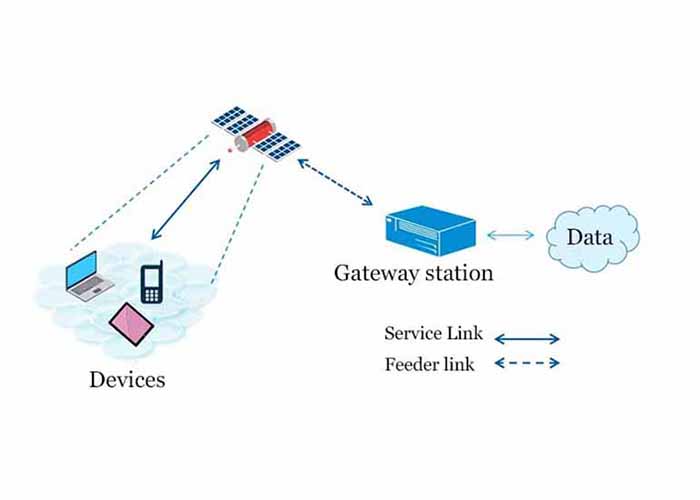
Base Station on Satellite is equivalent to the 5G base station deployed on the satellite, the interstellar link between the satellite and the satellite is the same as the Xn interface between the terrestrial base station, the feeder link between the satellite and the gateway station is part of the backhaul network between the base station and the core network, in simple terms, that is, the satellite has the function of a base station, you can process the data and then transmit it to the terminal.

Non-Terrestrial Network/NTN technology realisation
Unlike traditional mobile phone communication technology, satellite communication technology does not require mobile phones to be connected to a base station, but to achieve communication through the satellite.
Satellite communication is currently realised in two ways.
One is that satellite phones connect to satellites to achieve communication with other phones, as is the case with traditional satellite phones.
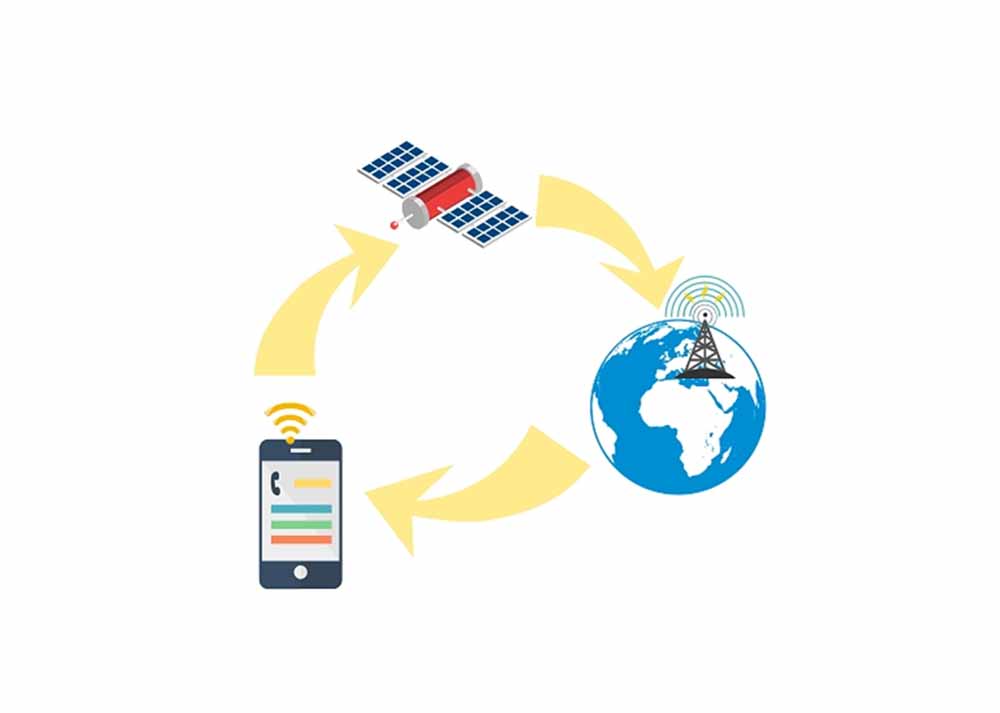
One is through NTN (Non-Terrestrial Network) technology, a satellite directly to the ground to provide 5G connectivity services, enabling mobile phones to communicate with each other, as shown in the figure below.

NTN is an important supplement to terrestrial cellular communication technology and is one of the technological directions for mobile phones to connect directly to satellites. Using the convergence of satellite communication networks and terrestrial 5G networks, it can provide ubiquitous coverage capabilities regardless of the limitations of terrain and landscape, connecting air, sky, earth, and sea multi-dimensional space to form an integrated ubiquitous access network, enabling full-scene on-demand access.
Over the past three decades, satellite communications and terrestrial cellular mobile communications have gradually moved from competition to integration. In the 1990s, LEO satellite communications and terrestrial cellular mobile communications (e.g., GSM) competed.
NTN is a direct communication technology between terminals and satellites based on new airport technology developed by 3GPP in the R17 phase, which enables smartphones to connect directly to satellites using the 5G NR framework to provide low-rate data and voice services. The NTN communication network is a powerful complement to terrestrial cellular communication networks, and is an important part of realising the future of seamless global coverage and ubiquitous connectivity covering a wide range of air, space, land, and sea applications.
What is 5G Non-Terrestrial Network?
5G Non-Terrestrial Network is a 3GPP-compliant solution for the convergence of satellite networks and terrestrial cellular networks, which is conducive to the formation of a scale of terminals and applications, reducing the cost of satellite connectivity, and realizing full-area coverage of the sky, the earth, and the sea.
5G Non-Terrestrial Network technology can support satellite communication networks to form networks alone or jointly with terrestrial cellular communication systems as a complementary network oriented to achieve star-ground converged communications. 5G Non-Terrestrial Network satellite networks can provide more complete signal coverage for mobile phones, penetrating deeper into areas that are difficult to reach by general terrestrial networks.
In addition, smartphones can also use satellite signals to access the Internet directly, combining the resources of existing terrestrial and satellite networks to form a seamless communication network, without the need for additional accessories for the mobile phone itself.
The wide application of 5G Non-Terrestrial Network technology is an effective way to build an integrated information network between heaven and earth.
The main advantages of 5G Non-Terrestrial Network technology are as follows.
The application of 5G Non-Terrestrial Network technology to satellite networks can change the customized and private characteristics of satellite communications, and is based on a large number of inherited technologies of terrestrial mobile communications.
It can obtain the support of a wide range of potential semiconductor components, assemblies and solution providers, effectively reduce the construction and maintenance costs of satellite communication systems, enhance the vitality of the industry, and promote its development, costs, enhance industrial vitality, and promote its openness, cooperation, and development.
At the same time, satellite networks can evolve together with 5G networks, reducing the cost of technology replacement while maintaining technological advancement.
Besides the What is Non-Terrestrial Network article. You may also be interested in the below.